텍스트를 입력해주세요
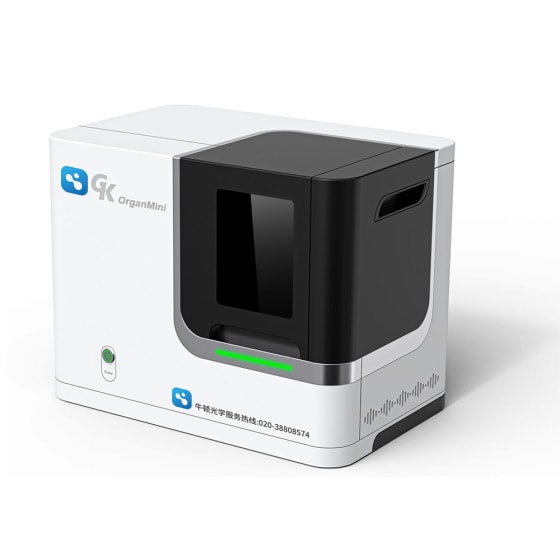

Anti-CT projection printing technology
This technology features non-contact and ultra-fast printing capabilities, overcoming the issues of slow printing speed and low cell survival rate associated with traditional contact bioprinters. Additionally, it is easy and quick to operate, with one-step molding, enabling the acquisition of centimeter-scale, highly viable three-dimensional tissues in just one minute.
High viability, High expression
The entire printing process takes place in a sealed printing bottle, utilizing visible light curing for integrated molding, rather than UV curing. It boasts fast printing speeds, no contact damage, no pollution, ensuring that the printed cell models maintain a cell survival rate of over 95% and a high expression levels*.
*Bernal et al. Advanced materials 2022


High-precision printing of structures
OrganMini employs a projection printing principle akin to "creating objects out of thin air", eliminating the need for supports or scaffolds to produce intricate three-dimensional models of complex structures such as microvessels, C60, skin, ears, and more. It also facilitates the simultaneous custom printing of multiple three-dimensional models.
*MB Xie, et al. Nature Communications, 2023
"One-click printing" software
We have specially designed the Haomiao printing software for OrganMini, which supports multi-user management. The software allows for fine adjustments of parameters such as position, rotation, size, light intensity, duration, and rotation speed. Additionally, the software comes pre-installed with a library of over 200 commonly used models to meet various needs.

Organoid construction leading solution
OrganMini boasts three core technologmicrospheres, eliminating the significant batch-to-batch variability inherent in manual
operations; Clinical validation has shown that this technological breakthroughs: 60-second ultra-fast integrated printing, which
supports the simultaneous printing of multiple organoid y can shorten the organoid construction cycle to 7-14 days, with a drug
screening accuracy rate of 83.3%.

Disruptive technology
Case1:The article exploring the mechanism by which ENO2 desensitizes colorectal cancer drugs has been published in Nature Metabolism。 Case2:Exploring the combination of pure silk fibroin ink and volumetric bioprinting, the article has been published in Nature Communication。 Case3:Exploring the relationship between decellularized extracellular matrix (dECM) and volumetric bioprinting, the article has been published in Advanced materials。

| General | |
| Nane | 3D volumetric bioprinter/3D material preparation instrument |
| Dimensions of imaging host | 460mm×270mm×320mm |
| Weight of imaging host | 13kg |
| Technical parameters | |
| Printing Time | 10-120s |
| Model Cell Viability | >95% |
| Printing Resolution | 50-300μm |
| Printing Size | 5-20mm |
| Printing Principle | Reverse CT Projection,One-step Forming, Support-free, Contactless |
| Printed Model Size | ≥1mm±0.5mm×1mm±0.5mm×1mm±0.5mm |
| Light Source | LED Visible Light Source with No Less Than Three Wavelength Bands |
| Wavelength | 385nm or 405nm or Visible Light RGB (460nm,523nm,635nm) |
| Model Library | Built-in Model Library with 200+ Common Models |
| Featured Functions | Multi-user Management Function: Organ Mini Features Embedded Slicing(Software Supports Self-slicing of User-created 3D Models) |
| Item number | |
| 3D volumetric bioprinter/3D material preparation instrument | T200(Host Machine, 5g Bioink, 1 Bottle of Photoinitiator, 1 Viability Analysi.Device) |
| OrganMini(Host Machine, 50g Bioink, 10 Bottles of Photoinitiator, 1 ViabilityAnalysis Device) | |