텍스트를 입력해주세요
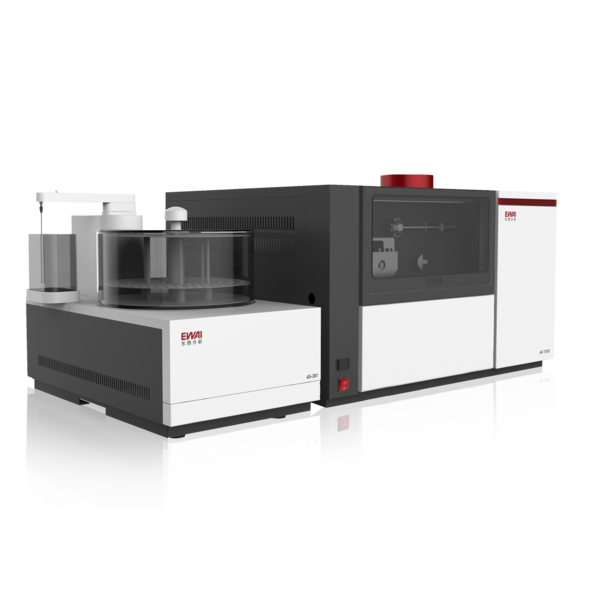
"A high-sensitivity, dual-channel analytical platform engineered for the precise and simultaneous determination of trace hydride-forming elements and mercury." The EWAI AF-7550 leverages advanced hydride generation technology coupled with high-performance atomic fluorescence spectrometry. Featuring a dual-channel optical design and a gas-liquid separation system, it delivers exceptionally low detection limits and outstanding stability for demanding trace element analyses.
Key Features
1. Simultaneous Dual-Channel Detection
Dual-Element Capability: Equipped with two independent optical channels, allowing the simultaneous determination of two elements (such as Arsenic and Antimony, or Selenium and Mercury) from a single sample injection to double laboratory throughput.
High-Intensity Optical Path: Utilizes high-intensity pulsed hollow cathode lamps as excitation sources, maximizing the signal-to-noise ratio and enhancing overall sensitivity.
2. Advanced Hydride Generation & Separation System
Efficient Gas-Liquid Separator: Features a low-dead-volume, high-efficiency gas-liquid separation system that ensures smooth analyte vapor transport while effectively eliminating moisture and baseline noise.
Automated Reagent Delivery: Incorporates a high-precision peristaltic pump system to guarantee stable, continuous, and reproducible mixing of samples and reducing agents.
3. Superior Dispersion Shielded Burner
Stable Atomization: Employs a unique quartz atomization cell wrapped in an automated argon shielding gas shield, which isolates the flame from ambient air interferences and prevents fluorescence quenching.
Automated Ignition: Supports software-controlled automatic ignition and real-time flame monitoring for enhanced operational convenience and safety.
4. Comprehensive Software & Safety Systems
User-Friendly Workstation: The dedicated software provides real-time signal graphics, automatic calibration curve generation, peak area/height integration modes, and comprehensive QC auditing.
Intelligent Protections: Built-in safety sensors monitor gas pressures, liquid levels, and exhaust pathways, automatically shutting down the system if any abnormalities are detected to protect laboratory personnel.
Specifications
Analytical Performance
Analyzed Elements: As, Sb, Bi, Se, Te, Pb, Sn, Ge, Hg, Cd, Zn (Hydride-forming and volatile elements)
Detection Limits (D.L.):
As, Sb, Bi $\le$ 0.01 $\mu$g/L
Hg, Cd $\le$ 0.001 $\mu$g/L
Se, Te $\le$ 0.01 $\mu$g/L
Linear Range: Greater than 3 orders of magnitude
Precision (RSD): $\le$ 1.0% for major elements
Optical and Gas Controls
Optical System: Short focal length, non-dispersive high-intensity optical system
Detector: High-quantum-efficiency, low-noise solar-blind photomultiplier tube (PMT)
Gas Flow Control: High-precision automated mass flow controllers (MFC) for carrier gas and shielding gas
Communication Interface: Standard USB/RS-232 connection to an external PC workstation
Applications
Environmental Safety: Trace-level screening of toxic heavy metals (like Arsenic and Mercury) in drinking water, industrial wastewater, soil extracts, and atmospheric particulates.
Food & Agriculture: Routine analysis of harmful elements in rice, crops, seafood, dairy products, and animal feed to meet strict food safety regulations.
Public Health & CDC: Clinical and toxicological testing of biological fluids (such as hair, blood, and urine) for trace heavy metal exposure.
Geological & Mining Exploration: Determination of volatile and pathfinder elements in geological surveys, mineral digests, and geochemical mapping.