텍스트를 입력해주세요
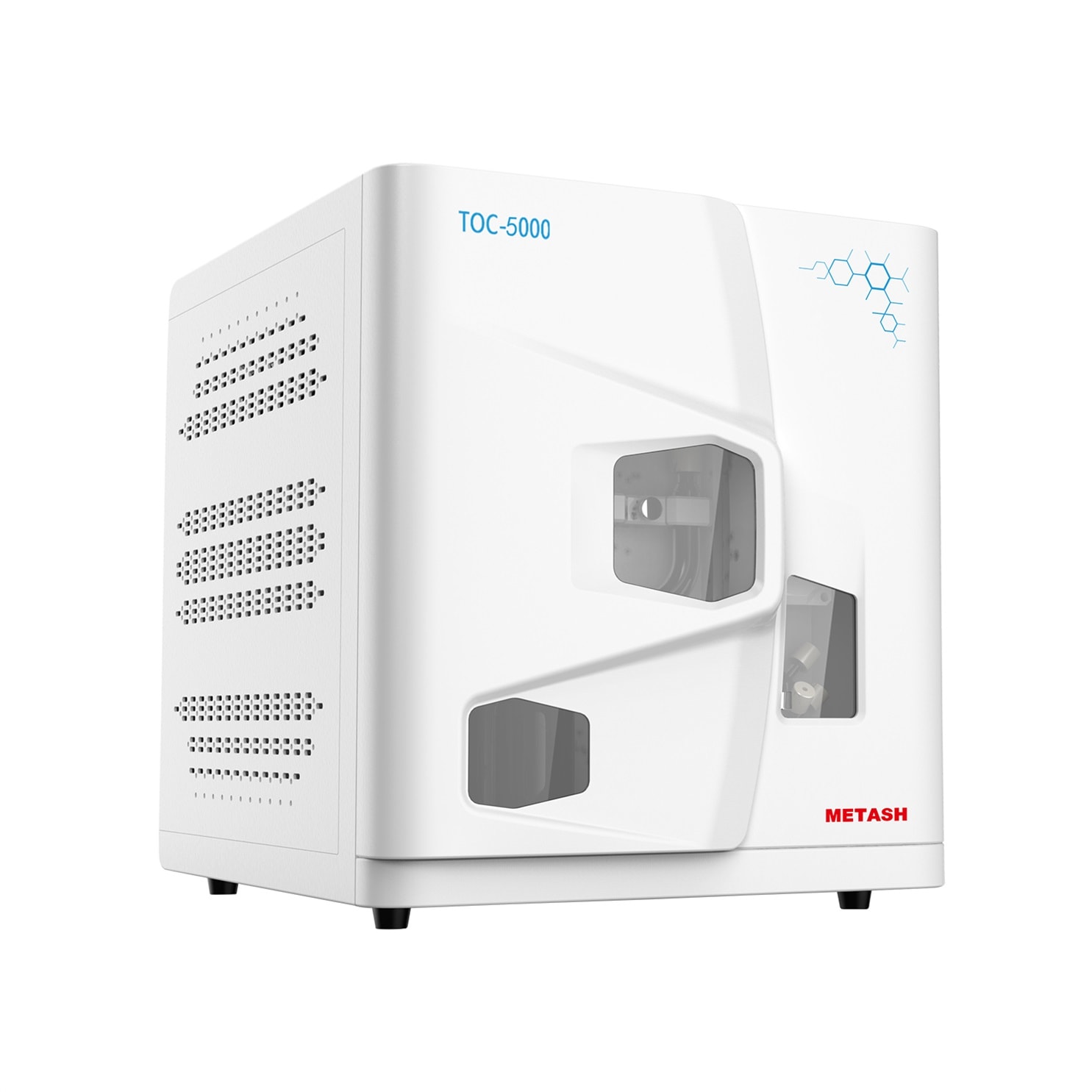
The TOC-5000 series, a high-temperature combustion Total Organic Carbon (TOC) analyzer manufactured by Metash, is generally classified into three operational versions depending on the level of laboratory automation and regulatory compliance required. This guide outlines the key functional and physical differences to help you choose the ideal model for your laboratory environment.
1. Key Functional Differences by Version
The TOC-5000 series is divided into three configurations based on its core hardware features, pre-treatment modules, and software options.
■ TOC-5000 RN (Standard PC Version)
This is the standard model utilizing conventional high-temperature catalytic oxidation ($680\text{ }^\circ\text{C}$ to $1,000\text{ }^\circ\text{C}$) paired with a highly stable NDIR detector.
Manual Dilution: If a sample concentration exceeds the default measurement range (0 to 1,000 mg/L), the operator must manually dilute the sample with DI water prior to injection.
Manual Pre-treatment: Acid addition and gas purging for Inorganic Carbon (IC) removal must be performed manually or through external preparation setups.
Recommended For: General water testing laboratories where sample concentrations are consistent, relatively low, and do not require automated dilution.
■ TOC-5000 RD (Auto-Dilution Version)
This is the advanced model that integrates all features of the RN version along with an add-on automated sample pre-treatment module.
Auto-Dilution: For high-concentration samples (up to 100,000 mg/L), the instrument automatically detects the over-range signal and dilutes the sample internally to fit the calibration curve.
Auto Pre-treatment: The system automatically injects acid and performs gas purging (Purging) during the sampling sequence, enabling seamless, one-touch Non-Purgeable Organic Carbon (NPOC) analysis.
Recommended For: Industrial wastewater plants, high-salinity seawater analysis, or high-throughput laboratories where manual pre-treatment creates an operational bottleneck.
■ TOC-5000 RN/RD + FDA 21 CFR Part 11 (Compliance Version)
This version utilizes either the RN or RD hardware frame but incorporates a specialized software package featuring an Audit Trail function.
Data Integrity Enforcement: It enforces strict digital signatures, multi-level user access controls, and immutable history logs, making it impossible to alter or delete raw analytical data undetected.
Recommended For: Pharmaceutical companies, biotechnology laboratories, and GMP-certified manufacturing plants that must strictly comply with global electronic record regulations (FDA 21 CFR Part 11 and international pharmacopeias).
2. Quick Comparison Table
| Feature / Specification | TOC-5000 RN (Standard) | TOC-5000 RD (Automated) | + FDA 21 CFR Version (Compliance) |
|---|---|---|---|
| Sample Dilution | Manual Dilution Required | Built-in Auto-Dilution | Depends on selected hardware (RN/RD) |
| Acid Addition & Purging | Manual / External Prep | Fully Automated Sequence | Depends on selected hardware (RN/RD) |
| Max Measurement Range | 0 to 1,000 mg/L | 0 to 100,000 mg/L (Auto-extended) | Based on selected hardware specifications |
| Data Security & Audit Trail | Standard PC Software | Standard PC Software | Advanced Security & Audit Trail Enabled |
| Target Environment | General Water Quality Labs | Complex Industrial & Seawater Labs | Pharmaceutical / Medical / GMP Facilities |
3. Physical and Visual Differences
A common question is whether these versions look different on the lab bench. The main chassis (Main Frame) dimensions and exterior styling are 100% identical across all three versions (sharing the exact same footprint of $450\text{ mm W} \times 500\text{ mm D} \times 480\text{ mm H}$).
However, micro-visual differences appear once the instruments are fully installed and configured:
Complexity of External Tubing (RD Version): Because the RD model handles internal dilution and automatic acid dosing, its back and side panels feature additional fluidic tubing lines connected directly to an external DI water reservoir and acid reagent bottles. It looks noticeably busier than the RN model.
Software Interface Indicators (FDA 21 CFR Version): The hardware remains identical to the standard builds, but the connected PC workstation will display a secure login prompt (electronic signature gate) and dedicated menu tabs for the Audit Trail registry.
Autosampler Expansion (All Versions): While all three baseline models support single-sample syringe injections, adding the optional liquid autosampler (Model AS-W20) places a large circular rotating sample tray holding dozens of vials next to the main chassis, significantly altering the overall system footprint.